
Zelda Foxall returns to Enl!ghten in honor of Women’s History Month. Zelda performs in-character vignettes of historically significant African American Women and co-founded the performing arts company, “Cause It’s Art.”
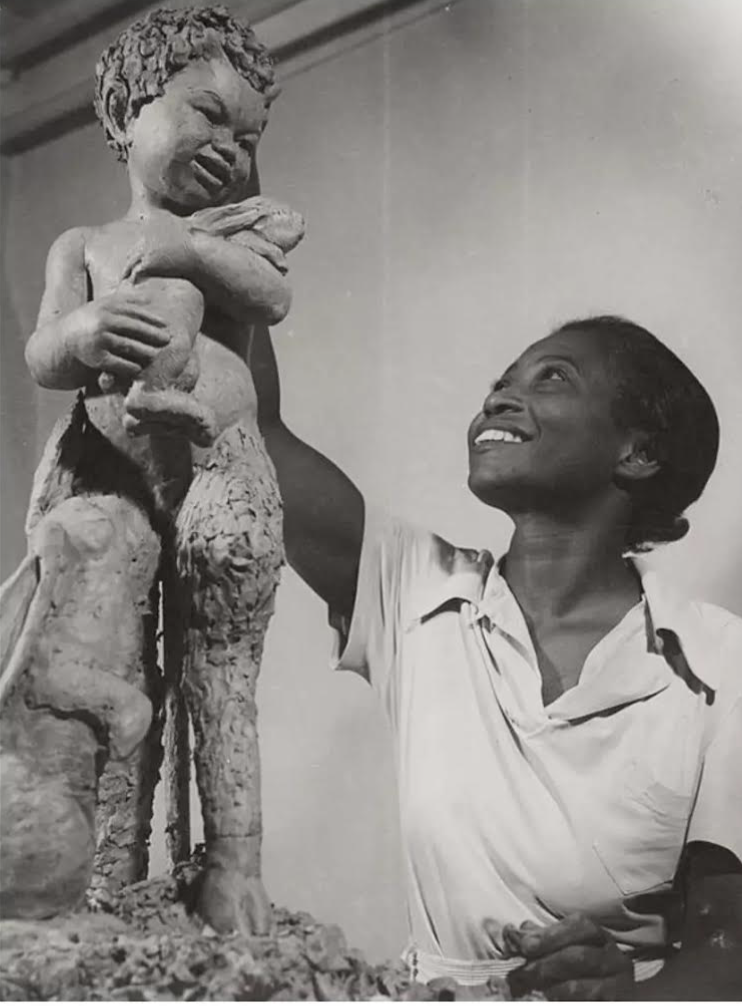
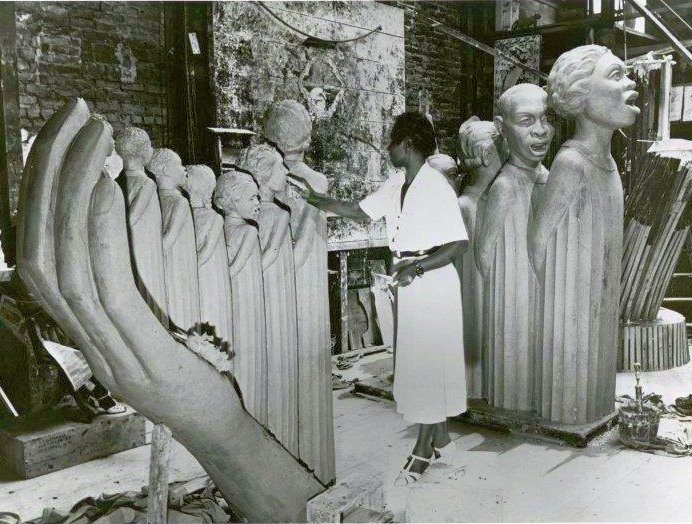
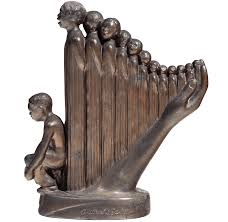
This month she will be portraying the Sculptor, Augusta Savage. Ms. Savage was one of the foremost female African American sculptors of her generation. She is best known for her small portrait sculptures of key civil rights figures. But her portrait bust of a young black youth (Gamin) helped earn her a commission for her most famous work “The Harp” for the 1939 New York World’s Fair.
Ms. Savage was in Harlem during the Harlem Renaissance where her work played a major role. She helped elevate Black culture and experience, and raised the profile of Black female artists, by gaining international recognition for busts of the leading political and cultural figures of that time, including W.E.B, Du Bois, James Weldon Johnson and Marcus Garvey.
Her work challenged the stereotypical ways that African Americans were depicted in art and popular culture. She was also instrumental in helping Black artists get noticed in the New York art scene based solely on the merits of their work. She said, “we do not ask any special favors as artists because of our race. We only want to represent to you our works and ask you to judge them on their merits. We accept your verdict on this basis and gladly rise or fall on our merit.”
aaa
Today, our society continues to question our humanity and how we are responding to the challenge of accepting differences based on race, color, sex, national origin and age. Jeffreen M. Hayes, an art historian, curator and author of the book Augusta Savage, Renaissance Woman, said: “Augusta Savage is a beacon from whom we can all learn—a voice from the past who speaks to the present about marginality, about the powerful potential of the voices and lives of the marginalized to produce change. She was a Black woman who created strategies to help her community to find within themselves the strength to live, strive, and thrive in a country that enforced boundaries that prevented their full humanity from being seen, respected, and celebrated.”
Among her many accomplishments, she was the first African American member of the National Association of Women Painters and Sculptors. She helped launch the famed Harlem Community Art Center where she mentored a generation of highly regarded artists including Romare Bearden, Jacob Lawerence and Gwendoly Knight Lawerence, wife of Jacob Lawerence. She founded several organizations that provided free art education and training to over 2,500 people in Harlem. She also became the first African American woman to open and manage a dedicated Black commercial art gallery.
Her influence is reflected in the White House where one of her students, Charles Alston, has a bust of Martin Luther King, on display. He is the first African American to have this honor.
But most importantly, her community-based teaching and her free “work-as-you-go classes” in Harlem showed her deep commitment to Black youth and adults and the power of art to change lives.She was most influential during the Harlem Renaissance and was well known in Harlem as a sculptor, art teacher, and community art program director. Through Zelda, Ms. Savage will step forward to tell her own story of how she overcame the tremendous odds to climb to the top of her field.
aaa
aaa